Showing posts with label study. Show all posts

Friday, 31 July 2015

167. Refreshment

Faber Castell 1.7 HB pencil on
Handbook Travelogue Journal, 5" x 5"

Hi everyone. I haven't run away and I have been doing a lot of painting - walls! We've spent a good chunk of the last three weeks refurbishing our church so it's been all hands on deck, sometimes till late at night, getting our beautiful old building ship-shape. All the stained glass has been delicately cleaned, the wood cleaned, waxed and buffed and the building looks and smells wonderful.

I took time out with Az to do some drawing - our challenge was a glass of water and what better receptacle than these fascinatingly intricate glasses. Talk about a challenge! I thoroughly enjoyed it though. (I deliberately under-crop these images so you get a sense of my sketchbook page.)

Saturday, 30 May 2015

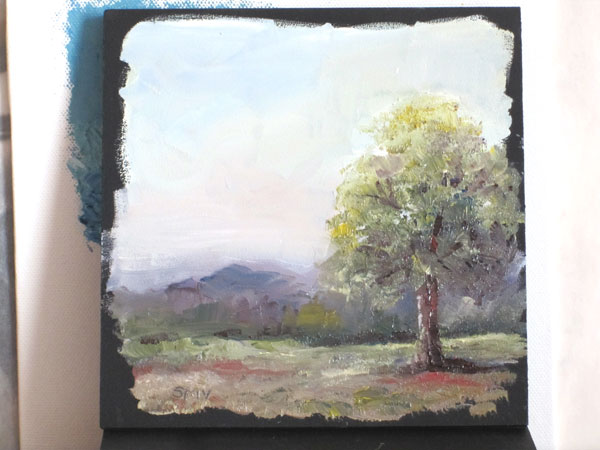
136. Quick Landscape Before Work

Oil on Black Gesso-primed Panel, 6" x 6"

Realising I was half an hour early for work, I quickly knocked this out. Fortunately, I'd had a palette of fresh paint at the ready. No time for loads of brushes or even brush cleaning between colours - I just kept wiping the brush on a bundle of 'blue paper'. It's not of anywhere in particular and I didn't even paint up to the edges of the panel. Terribly untidy for me but very satisfying!

Before cropping…

Sunday, 4 January 2015

107. After Paul Cezanne: Sketchbook Study of Still Life with Apples (1890)


(After Paul Cezanne)
Derwent Onyx Medium Pencil and Derwent Coloursoft Pencils, (A3) in A4 Sketchbook

This is my colour study for yet another Cezanne painting; can't resist his work!  I'll post up the finished painting tomorrow.  Happy creating everyone!

Saturday, 3 January 2015

106. After Paul Cezanne: Still Life with Peppermint Bottle, 1893-1895(?)


Still Life (after Paul Cezanne)
Oil on Pebeo Linen Canvas Board, 8" x 8"


Draft Sketch, Mars Lumograph Pencils: 2H and 7B, A4 sketchbook

Hi Folks.  I hope you are enjoying the challenge. I decided to copy another Cezanne painting (above) and it was just as enjoyable. He worked with all those tones, colours, shapes and patterns yet still he achieved a harmonious image - genius! Just for fun, I exaggerated further the cubic shapes of the two bottles and quite like how they turned out. Also above is my random sketchbook drawing (above) which I did simply to get a feel for the shapes and flow of the design. The original painting by Paul Cezanne is below.


The original painting by Paul Cezanne

Wednesday, 1 October 2014

103. Watercolour Study for Landscape


Study for Landscape, Watercolour on Bockingford Cold Pressed Paper


Pen and Ink tonal notan on cartridge paper

Monday, 26 May 2014

97. Firenze, Ti Amo!


The Dome of the Cathedral of Santa Maria del Fiore,
Pilot G-Tec C4 on A4 paper

Hi Everyone, we've just returned from a week in Florence to celebrate our birthdays and wedding anniversary. Within an hour of arriving, we sought out il Duomo. It is much more imposing in real life than in any photograph or sketch; the sight of it when you come around the corner and see it is amazing. Highly recommended.

I have lots of sketches and will post them up periodically.

Saturday, 10 May 2014

95. Gallery Sketches: Veronese


After Veronese, The Conversion of Mary Magdalene (c.1548), Pilot G-Tec C4 on paper

This is one of the best exhibitions I have ever attended and I've been to some very good ones. 

Again, during my OU studies years ago, we touched briefly on Veronese so it was such a privilege to be able to view 50 of his paintings in one (very large) place. The man was truly a genius, able to paint figures (and facial expressions), architecture, fabric, flora, fauna, textures, etc, etc. We were given a small booklet which contained a little introduction to each of the 50 paintings and I scribbled extra notes into it from the audio guide. I then wrote some of them up in the following few days. I think the two paintings above are my favourites but really, as 'Brucie' says, they're all my favourites!

We went in the middle of April but it runs until mid-June.

Friday, 9 May 2014

94. Gallery Sketches: de la Hyre and van Honthorst

Rendering fabric, Staedtler Mars Lumograph 100 3B on A4

In the first image, Vicky told us to choose a section of the painting, Allegory of Grammar (1650), and draw the folds by doing a line drawing of the shape of the fold then filling it in. That was excellent advice as it worked for me.  


Picking out highlights, Staedtler Mars Lumograph 100 3B on A4

We then took a clean sheet and blocked out an area by shading then used an eraser to pick out the highlights of the fabric. A few people preferred this method and produced lovely tonal drawings. To be honest, I preferred the line method but it could just be that I should have started with much darker shading.

Finally, we went into the next room and looked at van Honthorst's Christ Before the High Priest (top right); the painting has a very dark tone but is lovely. We then had to combine the two methods to show the light and shade in the painting. I enjoyed using both methods and, given more time, may have made it a bit darker. An excellent and informative session, as usual.

Sunday, 13 April 2014

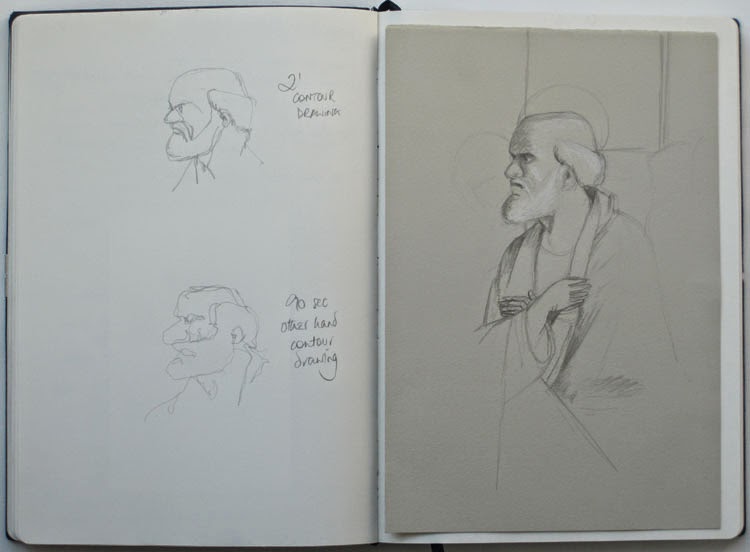
91. Gallery Sketches: Cima da Conegliano


Sketch of Peter,
a detail of Cima da Conegliano's The Incredulity of Saint Thomas,
Derwent Onyx Dark (just less than A4)

We were given a white pencil, a sheet of toned pastel paper and a sheet of white (I used my sketchbook for the exercises on white).


I must try to write in a straight line!


Two minutes dominant-hand, 90 minutes non-dominant hand
and the longer drawing.

After Katy's art historical explanation, Marc told us to pick one of the many faces and, starting with the nose, draw the head in 2 minutes. We then had to use our non-dominant hand and draw the same head in 90 seconds. He then told us to use the toned paper to draw a different head in one minute then turn it over and pick either of our chosen heads to work up a longer drawing. He wouldn't let us use the white pencil until towards the end when we were told to then focus on the highlights. Another excellent session.

Not shown are the images on the back of the toned paper but it's too dark now to photograph them. I owe you a photograph!

Saturday, 5 April 2014

90. Gallery Sketches: Anthony van Dyck


After Anthony Van Dyck (to whom it is attributed),
Sketch of Drunken Silenus being supported by Satyrs,
Derwent Watersoluble Sketching, Light, and Derwent Onyx Dark


The painting is in an elaborate frame with large flourishes at the halfway points, horizontally and vertically. One of the tutors suggested we start at the centre of the painting with Silenus then use those points on the frame as a guide, the way you'd use a grid when squaring up.

The session was full and the two preceding talks were excellent as ever. We were asked to draw the whole scene and quite a few people managed it, including tones, etc. I was being too nit-picky to start but then I got going. To be honest, I am happy with what I got down; I am really grateful for these sessions which provide an opportunity to refresh my art history and work from masters' paintings. At the end, we lay out and compare our efforts and we all agree that our drawing has improved because of these sessions.

Friday, 4 April 2014

89. Gallery Sketches: Pollaiuolo Brothers - Saint Sebastian


Life Model, Tom, assuming the archers' poses in the painting,
4 minutes (x2) then constantly moving through the poses,
Derwent watercolour sketching pencils on A4


Life Model, Tom, assuming the archers' poses in the painting,
12 minutes, Derwent watercolour sketching pencils on A4


The Martyrdom of Saint Sebastian, Antonio del Pollaiuolo and Piero del Pollaiuolo, 1475

Thursday, 3 April 2014

88. Gallery Sketches: Trek


Sketch of Jan Jansz Trek's Vanitas Still Life, 1648

I was looking forward to doing this painting as it looked to be a real challenge and a Vanitas painting is always so full of meaning. As it turns out, I felt the need to add some colour to it once I got home because there was so much detail, some of the elements were becoming lost. 


Jan Jansz Trek's Vanitas Still Life, 1648

Wednesday, 26 March 2014

87. Gallery Sketches: J M W Turner


(After J M W Turner.)
Conte and wax crayons on black pastel paper, A4


Above is a (wonky) photocopy of 
Margate(?) by the Sea by J M W Turner
and beneath it is my 5 minute sketch of the piece, Mars Lumograph 100.


Our instructions in this instance were to take the three colours given to us and use tone to re-create Turner's painting retaining the black of the paper for the darkest tone. The colours were sanguine and white Conte crayons and a yellow ochre wax crayon. It was impossible to work over the wax crayon so I just used it for the foreground grasses and blended the sky using the sanguine - hence the redness.

Can I see a smiley face on the page?

At the end of the session, we were asked to do another sketch of the painting but this time we only had five minutes so I opened my sketchbook and did it with a pencil (can't remember which grade).

Tuesday, 25 March 2014

86. Ten Minute Talk: Canaletto


Photocopy of The Stonemason's Yard by Canaletto and
pen and ink sketch of the painting, Pilot G-Tec C4 on 90g photocopy paper, 5" x 5.5"

I attended this 10 minute talk in the National as I was really early for the drawing session next door. This is a lovely big painting so my reproductions don't give it justice; it contains quite a few figures each with a story, including the child who has fallen over in the foreground and wet himself, poor thing!

It was in my OU art history that I discovered Canaletto and so I was thrilled to discover this painting being discussed. There are quite a few paintings by Canaletto and his studio at the gallery.

Monday, 24 March 2014

85. Drop-in Drawing: Armour


(After Sir Anthony van Dyck.)  Derwent Coloursoft on pastel paper, A4


On the left is a photocopy of 
Thomas Wentworth, 1st Earl of Strafford (1593-1641)
Studio of Sir Anthony van Dyck

A lot of people attended this event, including quite a few students and we spilled out over three rooms. A very enthusiastic and knowledgable tutor from New Zealand led us, together with other assistants from the gallery. She explained that, at the time, armour was more fashion than function and was very comfortable. People could also tell how wealthy the wearer was by the style and decoration. 

She told us to walk around and choose one of the many paintings by van Dyck depicting armour then collect some coloured paper and try to reproduce that armour. Some people also drew some of the high fashion seen in paintings of men and women in the surrounding rooms. I used my own pencils but had no coloured paper so used theirs.

My experience is that artists are very friendly people and this was no exception. These meets are a great way to work alongside and get to know a little about other artists (of all ages and abilities) as art can otherwise be a lonely business.

Thursday, 20 March 2014

83. Gallery Sketches: Pesellino and Fra Lippi


Sketch of The Pistoia Santa Trinita Altarpiece by
Francesco Pesellino and Fra Filippo Lippi and workshop,
Mars Lumograph 100 and Coloursoft pencils in A4 sketchbook


Initial sketches

Two weeks ago, I went to a talk on this lovely painting in Room 54 of the National. There were 40 seats set out for whoever wanted to come along. I had taken my own materials but all materials, including a drawing board, had been provided. There was a huge box of coloured pencils, enough so that the gentleman beside me had about 10 sticking out through his fingers!

We started with a 10' talk on the piece by a woman from one of the auction houses (shame, I've forgotten which one) and she also spoke to us about the little paintings included in the predella below the main image. Then a nice, enthusiastic artist called Mark guided us in what we should take into consideration when doing our sketches. He reminded us that the frame is important too as it's part of the whole image and he asked us to use colour to show how the fabric fell around the figures.

In my art history studies, I learned that this type of image is called a sacra conversazione (a 'sacred conversation') as characters from different times in history are grouped around the holy family. The figures I did in colour were St Jerome (347-420AD), the Bishop of Pistoia (15C) and an angel (timeless).

When the hour was up, Mark asked us to lay out our sketches so we could see how each person had interpreted the piece. There was some really lovely work and it initiated some great conversation while we packed away. Highly recommended.

Wednesday, 19 March 2014

82. Lilies and Roses


Still Life with Lilies and Roses, 3B Mars Lumograph 100,
in A4 sketchbook


Waitrose drastically reduced the price of their flowers so we got a great-smelling bunch of lilies and roses for half-price and I thought I'd sketch some of them for some practice. As it turned into a drawing (rather than just a sketch), I took my A5 sketchbook and did a quick pen and ink line drawing (below) which I quite like actually.


Still Life with Lilies and Roses, Pilot G-Tec C4 in A5 Moleskine

Have a good day!

Monday, 17 March 2014

80. Gallery Sketches: Rubens and Giordano


Sketch of Rubens' Minerva Protects Pax from Mars ('Peace and War'),
Derwent Onyx Dark in A4 sketchbook

This is a lovely big painting full of all sorts of wonderful textures. It's typical of many such mythological scenes that I studied years ago and is worth looking up. However, I didn't know that Rubens had presented this as a gift to Charles 1. 

Over the years, I've always been struck by the ability of these master artists to render different textures and Rubens is no exception; there is flesh, fur, hair, metal, foliage, fruit, fabric, jewellery, fluid, the sky - just lovely.

My sketch includes Pax but I didn't manage to get Minerva or any of the background war scenes done. She is the link from peace in the foreground ('Pax') and war in the background, signified of course by Mars.

I came home and printed out images of both these paintings as a reminder of what I'd been looking at. We had about 20 minutes for each of these; the Tour and Draw sessions last longer (90 minutes) than the Talk and Draw (an hour) to allow time for everyone to travel from room to room.


Sketch of Luca Giordano's Perseus Turning Phineas and His Followers to Stone,
Derwent Onyx Dark in A4 sketchbook

I love this painting! I was so glad Sarah chose this and our remit was to look at how Giordano has used controposto in some of the figures to show energy, particularly Perseus.  

For many years, artists have painted and sculpted all or part of this mythological scene - Sebastiano Ricci did a beautiful one with wonderful classical sculptures and architecture which, I think, more effectively shows the followers of Phineas turning to stone.

Nevertheless, this has been my favourite for a couple of reasons. When you look at it, you see that Giordano thought about the fact that Medusa's severed head could still turn the beholder to stone so he turns Perseus's head away while he thrusts it in the faces of his enemies; I also think the determined expression on his young face shows authority and maturity. Giordano has taken advantage of this to effect the contraposto stance. 

The second reason is just the sumptuous fabric in Perseus's costume. Now you know I love blue and these blues set against the gold, ochre and bronze elements are just delicious.

Finally, look at the expression of Medusa, or no, maybe you shouldn't!! Oh-oh.....

Tuesday, 14 January 2014

62. Day Fourteen: Road to Harpenden


Landscape, oil on acrylic-primed Pebeo canvas board,
10cm x 10cm (approx. 4" x 4")

Good morning fellow painters, I didn't envisage having time to paint today but woke up at 4:30am and, still wide awake an hour later, decided to do this little study using only a palette knife to apply the paint.  It's fiddly to work so small with a knife but, like most things, I guess it just takes a little practise.

The colour you can see peeping around the edges of the image is Quinacridone Magenta acrylic.  It was left over from something else so I used it as an imprimatura layer on a few little supports.

Off to work shortly; wishing you all a successful day.